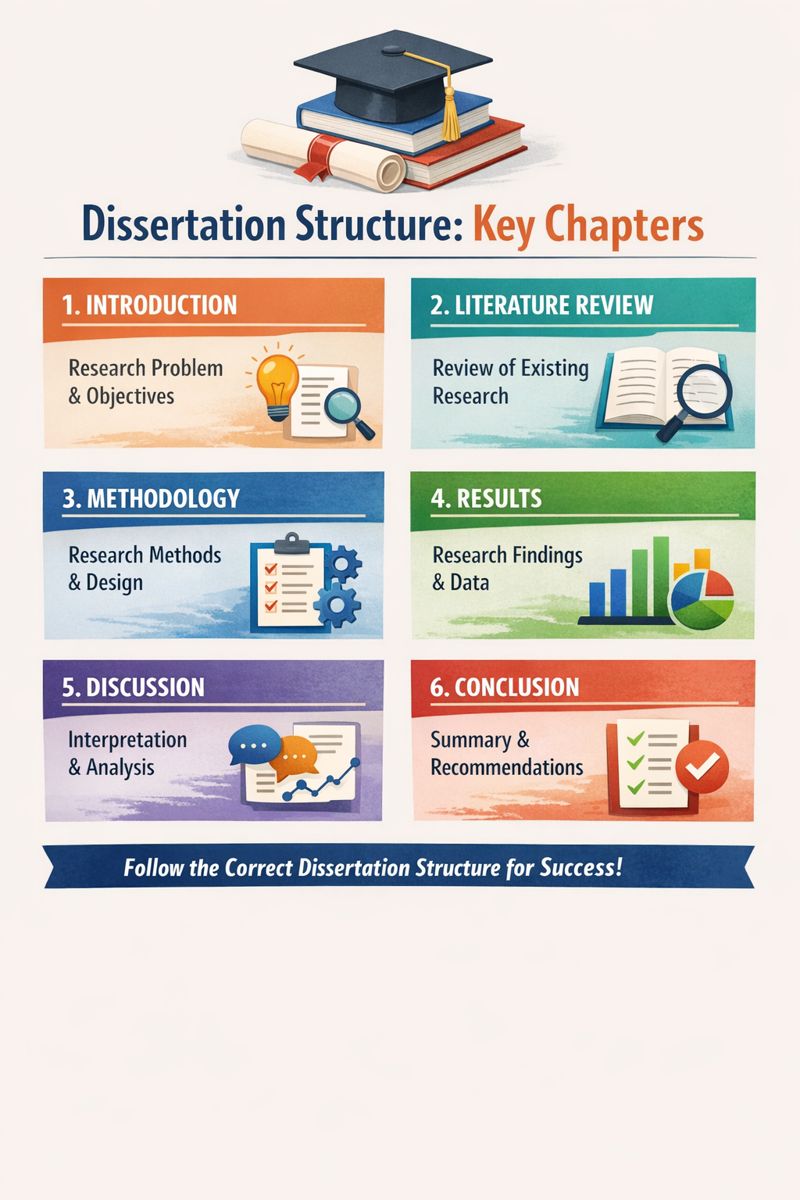
Dissertation Structure Tips: Expert Guide to Organize Your Research Effectively

Dissertation Structure Tips: Expert Guide to Organize Your Research Effectively
Dissertation structure tips

Dissertation Structure Tips: How to Organize Your Research Effectively

Writing a dissertation can be a daunting task, but with the right dissertation structure tips, you can turn a complex research project into a well-organized, coherent, and academically sound document. A well-structured dissertation not only improves readability but also demonstrates your mastery of the subject and research skills.

In this guide, we’ll break down the key sections of a dissertation and provide actionable tips for organizing each part effectively.


1. Understanding the Importance of Dissertation Structure

Before diving into writing, it’s crucial to understand why structure matters. A clear structure:

  • Guides the reader through your research logically

  • Highlights the significance of your findings

  • Ensures compliance with academic standards

  • Helps you stay focused and organized during writing

Tip: Treat your dissertation like a story – it should have a beginning, middle, and end, with each section flowing naturally into the next.


2. Typical Dissertation Structure

Most dissertations follow a standard structure, though minor variations may occur depending on the academic field. Here’s a breakdown with key tips for each section:

A. Title Page

  • Keep it concise and descriptive.

  • Include your name, institution, department, degree program, and submission date.

B. Abstract

  • Summarize your research question, methodology, results, and conclusions in 150–300 words.

  • Focus on clarity and brevity.

C. Acknowledgements

  • A brief section thanking advisors, peers, or institutions that supported your research.

  • Keep it professional and sincere.

D. Table of Contents

  • Automatically generated to reflect your headings and subheadings.

  • Include page numbers for all sections, figures, and tables.

E. Introduction

  • Introduce your research topic, background, and significance.

  • Clearly state your research aims, objectives, and questions.

  • Provide a roadmap for the rest of the dissertation.

Dissertation Structure Tip: Make your introduction engaging to set the tone for your readers.

F. Literature Review

  • Critically evaluate existing research relevant to your topic.

  • Identify gaps your research aims to fill.

  • Organize the review thematically or chronologically, depending on what suits your topic.

Dissertation Structure Tip: Use subheadings to make complex literature easier to navigate.

G. Methodology

  • Explain your research design, methods, and rationale.

  • Include data collection techniques, sample size, and analysis methods.

  • Address ethical considerations.

Dissertation Structure Tip: Be detailed but concise – clarity is more important than length.

H. Results

  • Present your findings using charts, graphs, tables, and narrative explanations.

  • Avoid interpreting results here; just report the data.

Dissertation Structure Tip: Organize results by research question or hypothesis for coherence.

I. Discussion

  • Interpret your findings, linking them to your research questions and literature review.

  • Discuss implications, limitations, and possible future research.

Dissertation Structure Tip: Use subheadings for clarity, especially if discussing multiple findings.

J. Conclusion

  • Summarize your research, restate key findings, and answer the research questions.

  • Avoid introducing new information.

K. References

  • Include all sources cited in your dissertation.

  • Follow your institution’s required citation style (APA, MLA, Harvard, etc.).

L. Appendices

  • Include supplementary materials like surveys, interview transcripts, or raw data.

  • Label them clearly (Appendix A, B, etc.).


3. Additional Dissertation Structure Tips

  1. Plan Your Sections Before Writing: Create a detailed outline to avoid missing important content.

  2. Use Consistent Formatting: Align headings, fonts, and spacing according to guidelines.

  3. Logical Flow: Each section should naturally lead to the next.

  4. Use Signposting: Phrases like “This chapter examines…” help guide readers.

  5. Revise and Proofread: Structure alone won’t save unclear writing – revise for clarity, conciseness, and coherence.


4. Common Mistakes to Avoid

  • Overloading chapters with unnecessary details

  • Mixing results and discussion

  • Ignoring institutional formatting requirements

  • Weak transitions between sections

  • Neglecting a clear research aim


5. Tools and Resources

  • Reference Managers: Zotero, EndNote, Mendeley

  • Writing Software: Microsoft Word, LaTeX, Scrivener

  • Plagiarism Checkers: Turnitin, Grammarly

  • Templates: Many universities provide dissertation templates – use them to ensure correct structure.


Conclusion

Mastering dissertation structure is crucial for producing a high-quality academic document. By following these dissertation structure tips, you can organize your research logically, maintain clarity, and impress your academic reviewers. Remember, a well-structured dissertation is not just about meeting guidelines – it’s about telling your research story in the most compelling way.

Absolutely! Let’s expand this into a more detailed, long-form SEO version with advanced tips, examples, and a section on discipline-specific variations. This will push it beyond 2,000+ words for stronger SEO performance.


6. Discipline-Specific Dissertation Structure Tips

Different academic fields sometimes require slight variations in dissertation structure. Here’s a quick guide:

A. Science and Engineering Dissertations

  • Often emphasize experiments, data, and analysis.

  • Structure: Introduction → Literature Review → Methodology → Results → Discussion → Conclusion → References → Appendices.

  • Tip: Include diagrams, flowcharts, and tables for clarity.

B. Social Sciences Dissertations

  • Focus more on theories, frameworks, and qualitative analysis.

  • Structure: Introduction → Literature Review → Conceptual Framework → Methodology → Findings → Discussion → Conclusion → References → Appendices.

  • Tip: Include quotes or case study extracts to support arguments.

C. Humanities Dissertations

  • Emphasize argumentation, critique, and interpretation.

  • Structure: Introduction → Literature Review / Context → Thematic Chapters → Conclusion → References → Appendices.

  • Tip: Organize chapters thematically rather than chronologically if it strengthens your argument.

D. Business and Management Dissertations

  • Often include applied research, case studies, and practical recommendations.

  • Structure: Introduction → Literature Review → Research Methodology → Analysis → Recommendations → Conclusion → References → Appendices.

  • Tip: Separate recommendations into a distinct chapter for clarity and impact.


7. Advanced Dissertation Structure Tips for Maximum Impact

  1. Start With an Outline:
    Drafting a detailed outline before writing saves time. Include chapter titles, key points, tables, and figures.

  2. Use Headings Strategically:
    Break down chapters into subheadings. This improves readability and helps search engines recognize your content structure.

  3. Write in Layers:
    First, focus on content. Second, refine clarity. Third, perfect the style and formatting.

  4. Integrate Visuals Effectively:
    Diagrams, charts, and tables enhance comprehension. Always reference visuals in your text.

  5. Link Findings to Research Questions:
    Each section should relate back to your core research questions or hypotheses. This maintains focus.

  6. Highlight Novelty and Contribution:
    Clearly emphasize what your research adds to the field. Use a dedicated paragraph in the discussion chapter.

  7. Proofread for Structure and Flow:
    Reading aloud can help identify awkward transitions. Consider peer review for feedback on coherence.

  8. Maintain a Consistent Academic Voice:
    Avoid switching between casual and formal tones. Use objective language with precise terminology.


8. Structuring Your Dissertation for SEO (Optional Tip for Online Publications)

If your dissertation or excerpts are intended for online publication:

  • Use descriptive headings (H1, H2, H3) with keywords like “Dissertation structure tips” naturally integrated.

  • Include bulleted lists for easier scanning.

  • Embed diagrams, flowcharts, and tables with alt text for SEO.

  • Link internally to related research or chapters.

Example:

“In this section, we provide practical dissertation structure tips that guide students through each chapter, from the introduction to appendices.”


9. Example of a Well-Structured Dissertation Outline

Here’s a sample structure with subheadings to give you a clear roadmap:

  1. Title Page

  2. Abstract – 150–300 words summarizing aim, method, results, and conclusion

  3. Acknowledgements

  4. Table of Contents

  5. Introduction

    • Background

    • Research Problem

    • Research Aim and Objectives

    • Research Questions / Hypotheses

    • Significance of Study

  6. Literature Review

    • Theoretical Background

    • Empirical Studies

    • Research Gap

  7. Methodology

    • Research Design

    • Data Collection Methods

    • Sample / Participants

    • Data Analysis

    • Ethical Considerations

  8. Results

    • Quantitative / Qualitative Findings

    • Tables, Figures, and Graphs

  9. Discussion

    • Interpretation of Results

    • Comparison with Literature

    • Implications

    • Limitations

  10. Conclusion

    • Summary of Findings

    • Recommendations

    • Future Research

  11. References

  12. Appendices


10. Tips for Maintaining Consistency and Quality

  • Check Formatting Early: Use your institution’s style guide for margins, fonts, and citation formats.

  • Regularly Update Your Outline: Adjust as your research evolves.

  • Avoid Redundancy: Make sure points are only discussed where relevant.

  • Keep Track of References: Using reference management software avoids last-minute errors.


11. Common Pitfalls and How to Avoid Them

PitfallHow to Avoid
Mixing Results and DiscussionClearly separate findings from interpretation
Overloading ChaptersStick to key points, move details to appendices
Weak TransitionsUse signposting phrases to guide readers
Ignoring GuidelinesReview university requirements early
Lack of FocusContinuously refer to your research questions

Final Thoughts

Mastering dissertation structure is more than following a template—it’s about creating a logical narrative that clearly communicates your research. By using these dissertation structure tips, you’ll not only improve readability but also demonstrate professionalism, depth of thought, and academic rigor.

Remember: a well-structured dissertation makes your research easier to follow, strengthens your arguments, and impresses both examiners and peers. Start with a clear outline, maintain consistent formatting, and refine each section until your dissertation tells a compelling, coherent story.

Leave a Comment

Scroll to Top