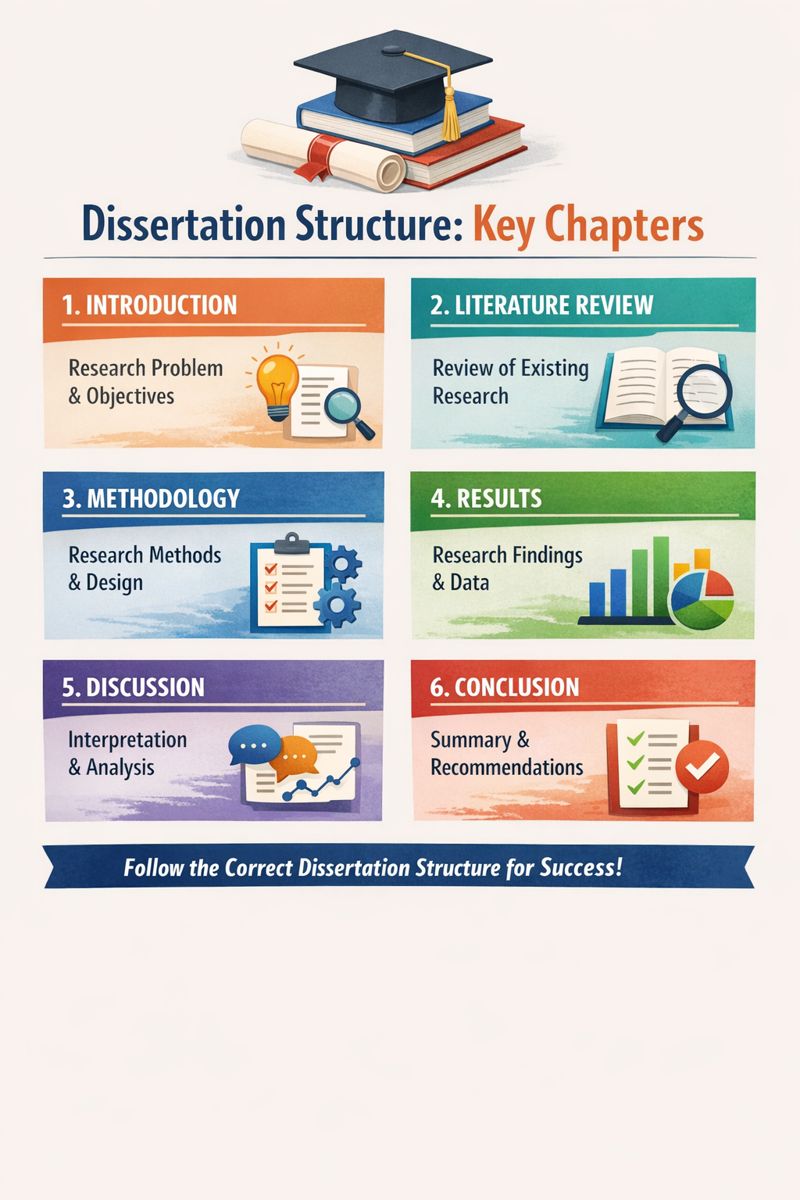
Dissertation Structure: A Complete Guide (With Examples)
A dissertation structure is the blueprint that shapes your research into a coherent and logical document. Whether you’re writing an undergraduate dissertation or a PhD thesis, understanding the correct structure is essential to presenting your research clearly and professionally.
In this guide, we break down the ideal dissertation structure, chapter by chapter, including what to include in each section and helpful tips to write a strong dissertation.
What Is Dissertation Structure?
Dissertation structure refers to the order and organization of the chapters and sections in your dissertation. A well-structured dissertation helps you:
Present your research logically
Communicate findings clearly
Build a strong academic argument
Follow university guidelines
Improve readability and flow
Most universities require a specific dissertation structure. However, the structure may vary slightly depending on your field (e.g., Humanities, Social Sciences, Engineering, Business, Medicine).
Standard Dissertation Structure (Most Common)
Here is the typical dissertation structure used by most universities:
1. Title Page
Your dissertation title should be clear, concise, and informative.
Includes:
Title of dissertation
Your name
Institution name
Degree program
Date of submission
2. Abstract
The abstract is a short summary of your dissertation.
Includes:
Research aim
Methods used
Key findings
Conclusion
Implications
📌 Tip: Write your abstract last after completing the entire dissertation.
3. Acknowledgements
A brief section where you thank people who supported your research.
4. Table of Contents
A list of chapters and sections with page numbers.
5. Introduction
The introduction sets the stage for your research.
Includes:
Background information
Research problem
Research questions
Objectives
Significance of the study
Scope and limitations
6. Literature Review
This section reviews existing research related to your topic.
Includes:
Key theories
Previous research findings
Gaps in literature
How your research fills the gap
📌 Tip: Use subheadings to organize themes.
7. Methodology
Your methodology explains how you conducted the research.
Includes:
Research design
Data collection methods
Sampling
Ethical considerations
Data analysis methods
8. Results / Findings
Present your research findings clearly and objectively.
Includes:
Data tables
Graphs and charts
Key results
Summary of findings
9. Discussion
Interpret your results and explain their meaning.
Includes:
Comparison with existing research
Implications
Limitations
Recommendations
10. Conclusion
Summarize the key findings and state the final conclusion.
Includes:
Summary of main findings
Contribution to knowledge
Recommendations for future research
11. References
List all sources cited in your dissertation.
Tip: Use a consistent referencing style (APA, Harvard, MLA, Chicago).
12. Appendices
Include supplementary materials such as:
Survey questionnaires
Interview transcripts
Additional data tables
Dissertation Structure Example (Sample)
Here is a sample dissertation structure for a social science topic:
Title Page
Abstract
Acknowledgements
Table of Contents
Chapter 1: Introduction
Chapter 2: Literature Review
Chapter 3: Methodology
Chapter 4: Results
Chapter 5: Discussion
Chapter 6: Conclusion & Recommendations
References
Appendices
Tips for Writing a Strong Dissertation Structure
✅ Use Clear Headings and Subheadings
Headings help your reader navigate your work.
✅ Maintain Logical Flow
Each chapter should link naturally to the next.
✅ Follow Your University Guidelines
Always check your institution’s dissertation structure requirements.
✅ Keep Your Chapters Balanced
Avoid making one chapter too long while others are short.
Common Dissertation Structure Mistakes to Avoid
❌ Skipping the literature review
❌ Not explaining methodology clearly
❌ Mixing results and discussion
❌ Weak conclusion without clear findings
❌ Incorrect referencing style
Final Thoughts
A strong dissertation structure is the foundation of a successful research project. When your dissertation is well-organized, your ideas become clearer, your arguments stronger, and your research more credible.
If you follow the standard dissertation structure and write each section carefully, you’ll significantly improve your chances of achieving a high grade.
Want a Custom Dissertation Structure for Your Topic?
If you share your subject area and research title, I can help you create a tailored dissertation structure that fits your university requirements.
Dissertation Structure: Full Guide (Continued)
1. The Importance of a Strong Dissertation Structure
A well-structured dissertation is not only easier to read but also shows your examiner that you have a clear understanding of academic writing and research design. Structure matters because:
It guides the reader through your research.
It creates a logical flow from the problem to the solution.
It helps you stay organized while writing.
It supports your argument and strengthens your conclusion.
2. Dissertation Structure by Chapter (Detailed)
Chapter 1: Introduction (Detailed)
The introduction should set the tone for your entire dissertation.
What to include:
Background of the study: Provide context for your research.
Problem statement: What issue are you addressing?
Research questions: What are you trying to find out?
Research objectives: What do you aim to achieve?
Significance of the study: Why is your research important?
Scope and limitations: What will you cover, and what will you not cover?
Definitions of key terms: Explain important concepts.
📌 Tip: Keep the introduction clear and avoid too much detail. Save the details for the literature review and methodology.
Chapter 2: Literature Review (Detailed)
The literature review shows your understanding of existing research.
What to include:
Key theories and models
Critical evaluation of previous studies
Trends in research
Gaps in existing literature
How your research contributes to the field
📌 Tip: Use subheadings to organize your literature review by themes or topics.
Chapter 3: Methodology (Detailed)
Your methodology explains how you conducted the research.
What to include:
Research design: Qualitative, quantitative, or mixed methods.
Research instruments: Surveys, interviews, observation, etc.
Sampling methods: How you selected participants.
Data collection process: How you gathered data.
Data analysis techniques: How you processed and analyzed data.
Ethical considerations: Consent, confidentiality, and data protection.
📌 Tip: Provide enough detail so another researcher can replicate your study.
Chapter 4: Results (Detailed)
The results chapter should present your data without interpretation.
What to include:
Data tables and charts
Key findings
Summary of results
📌 Tip: Use visuals like tables and graphs to make data easier to understand.
Chapter 5: Discussion (Detailed)
In the discussion chapter, interpret your results and explain what they mean.
What to include:
Interpretation of results
Comparison with existing literature
Implications of findings
Limitations of the study
Recommendations for future research
📌 Tip: Link your discussion back to your research questions.
Chapter 6: Conclusion (Detailed)
The conclusion summarizes your study and provides final thoughts.
What to include:
Summary of key findings
Final conclusion
Recommendations for practice or future research
Contribution to knowledge
3. Dissertation Structure for Different Fields
Different academic fields may have slightly different dissertation structures. Below are some examples.
Business & Management Dissertation Structure
Introduction
Literature Review
Research Methodology
Findings & Analysis
Discussion
Conclusion & Recommendations
Engineering Dissertation Structure
Introduction
Literature Review
Research Methodology
System Design / Prototype
Results & Testing
Discussion
Conclusion
Humanities Dissertation Structure
Introduction
Literature Review
Theoretical Framework
Analysis
Discussion
Conclusion
4. Dissertation Structure Checklist (Quick Summary)
Use this checklist to ensure your dissertation structure is complete:
✅ Title Page
✅ Abstract
✅ Acknowledgements
✅ Table of Contents
✅ Introduction
✅ Literature Review
✅ Methodology
✅ Results
✅ Discussion
✅ Conclusion
✅ References
✅ Appendices
5. Frequently Asked Questions (FAQ)
Q1. What is the best dissertation structure?
The best dissertation structure is the one that follows your university guidelines and presents your research in a clear, logical way. The standard structure includes introduction, literature review, methodology, results, discussion, and conclusion.
Q2. How long should each dissertation chapter be?
Chapter length depends on the total word count. However, a common guideline is:
Introduction: 10–15%
Literature Review: 25–30%
Methodology: 10–15%
Results: 15–20%
Discussion: 20–25%
Conclusion: 5–10%
Q3. Can I change the dissertation structure?
Yes, but only if your supervisor approves. Some topics require additional chapters such as:
Case study analysis
Design and implementation
Policy review
Technical evaluation
6. Conclusion
A strong dissertation structure is crucial for organizing your research and presenting it professionally. By following the standard dissertation structure and using clear chapter organization, you can improve your writing, strengthen your argument, and increase your chances of success.