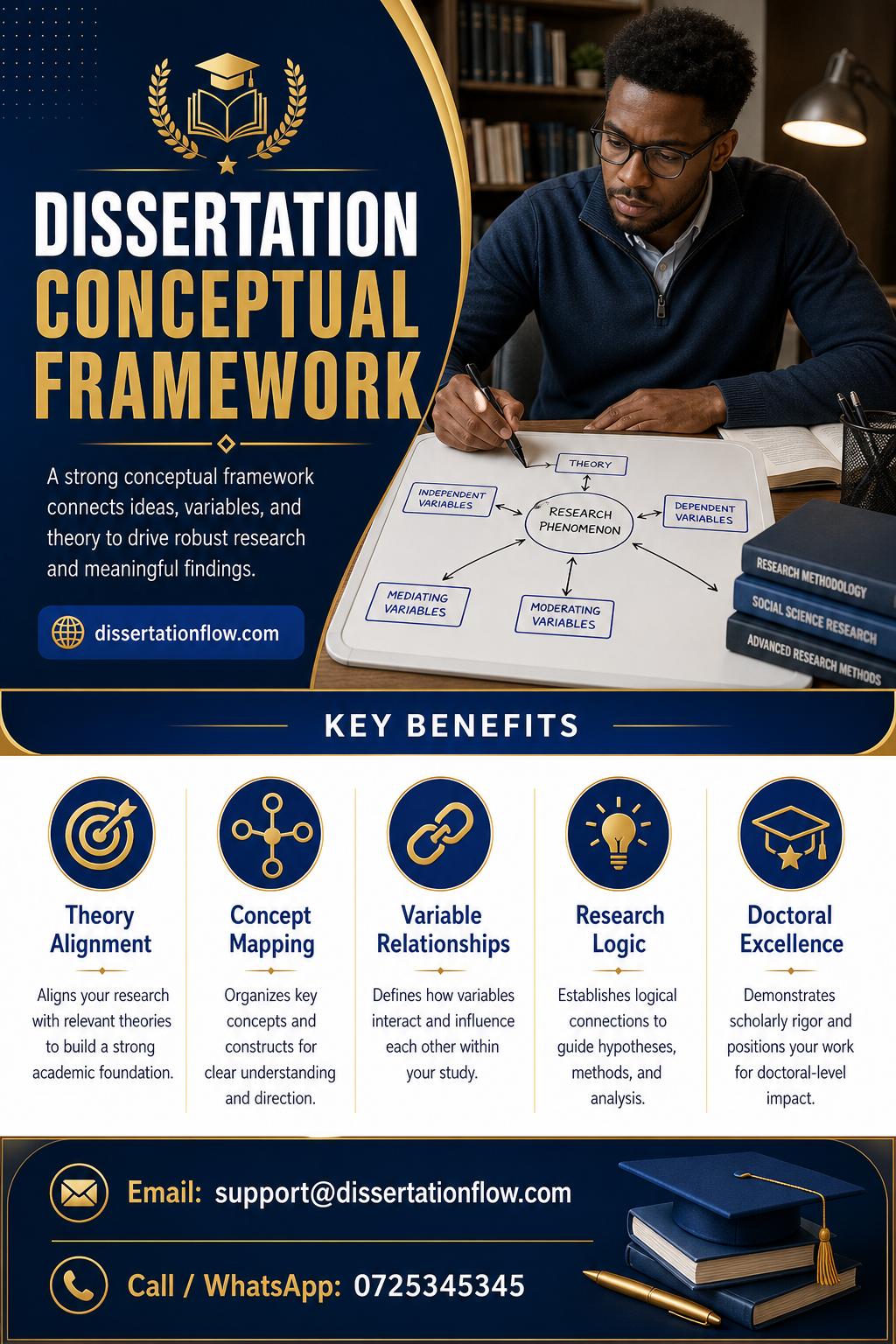
dissertation conceptual framework provides a structured learning process for postgraduate researchers connecting concepts, variables and expected relationships. This guide focuses on planning, evidence, reasoning, editing and responsible academic use rather than shortcuts or submission-ready work that bypasses learning.
Start with the current prompt, rubric, required sources, citation style and institutional academic-integrity policy. Use support to understand difficult requirements, improve an original draft and build skills that transfer to future assignments.
Table of Contents
- 1. Restate the research problem
- 2. Identify central concepts
- 3. Review relevant theories
- 4. Define each construct
- 5. Explain proposed relationships
- 6. Align with research questions
- 7. Create the framework diagram
- 8. Describe assumptions and boundaries
- 9. Check chapter alignment
1. Restate the research problem for dissertation conceptual framework
Restate the research problem begins with the exact rubric and learning outcome. Students should identify what must be demonstrated, which evidence is acceptable and how the section contributes to the overall academic purpose. For postgraduate researchers connecting concepts, variables and expected relationships, this prevents a technically correct detail from becoming disconnected from the assignment question.
A responsible approach to restate the research problem separates source evidence, interpretation and student decisions. State what is known, explain why it matters and show how the conclusion follows. When information is incomplete, acknowledge the limitation and identify what further evidence would be required.
2. Identify central concepts for dissertation conceptual framework
A responsible approach to identify central concepts separates source evidence, interpretation and student decisions. State what is known, explain why it matters and show how the conclusion follows. When information is incomplete, acknowledge the limitation and identify what further evidence would be required.
Quality checking identify central concepts requires specificity, support, relevance and logical flow. Accurate terminology and focused paragraphs make complex material easier to evaluate. Examples may illustrate the reasoning process, but students should adapt every choice to their own prompt, course policy and instructor guidance.
3. Review relevant theories for dissertation conceptual framework
Quality checking review relevant theories requires specificity, support, relevance and logical flow. Accurate terminology and focused paragraphs make complex material easier to evaluate. Examples may illustrate the reasoning process, but students should adapt every choice to their own prompt, course policy and instructor guidance.
Review relevant theories begins with the exact rubric and learning outcome. Students should identify what must be demonstrated, which evidence is acceptable and how the section contributes to the overall academic purpose. For postgraduate researchers connecting concepts, variables and expected relationships, this prevents a technically correct detail from becoming disconnected from the assignment question.
Continue with the related internal guide, Dissertation Data Analysis Plan: 9 Methodology Decisions.
4. Define each construct for dissertation conceptual framework
Define each construct begins with the exact rubric and learning outcome. Students should identify what must be demonstrated, which evidence is acceptable and how the section contributes to the overall academic purpose. For postgraduate researchers connecting concepts, variables and expected relationships, this prevents a technically correct detail from becoming disconnected from the assignment question.
A responsible approach to define each construct separates source evidence, interpretation and student decisions. State what is known, explain why it matters and show how the conclusion follows. When information is incomplete, acknowledge the limitation and identify what further evidence would be required.
5. Explain proposed relationships for dissertation conceptual framework
A responsible approach to explain proposed relationships separates source evidence, interpretation and student decisions. State what is known, explain why it matters and show how the conclusion follows. When information is incomplete, acknowledge the limitation and identify what further evidence would be required.
Quality checking explain proposed relationships requires specificity, support, relevance and logical flow. Accurate terminology and focused paragraphs make complex material easier to evaluate. Examples may illustrate the reasoning process, but students should adapt every choice to their own prompt, course policy and instructor guidance.
6. Align with research questions for dissertation conceptual framework
Quality checking align with research questions requires specificity, support, relevance and logical flow. Accurate terminology and focused paragraphs make complex material easier to evaluate. Examples may illustrate the reasoning process, but students should adapt every choice to their own prompt, course policy and instructor guidance.
Align with research questions begins with the exact rubric and learning outcome. Students should identify what must be demonstrated, which evidence is acceptable and how the section contributes to the overall academic purpose. For postgraduate researchers connecting concepts, variables and expected relationships, this prevents a technically correct detail from becoming disconnected from the assignment question.
7. Create the framework diagram for dissertation conceptual framework
Create the framework diagram begins with the exact rubric and learning outcome. Students should identify what must be demonstrated, which evidence is acceptable and how the section contributes to the overall academic purpose. For postgraduate researchers connecting concepts, variables and expected relationships, this prevents a technically correct detail from becoming disconnected from the assignment question.
A responsible approach to create the framework diagram separates source evidence, interpretation and student decisions. State what is known, explain why it matters and show how the conclusion follows. When information is incomplete, acknowledge the limitation and identify what further evidence would be required.
8. Describe assumptions and boundaries for dissertation conceptual framework
A responsible approach to describe assumptions and boundaries separates source evidence, interpretation and student decisions. State what is known, explain why it matters and show how the conclusion follows. When information is incomplete, acknowledge the limitation and identify what further evidence would be required.
Quality checking describe assumptions and boundaries requires specificity, support, relevance and logical flow. Accurate terminology and focused paragraphs make complex material easier to evaluate. Examples may illustrate the reasoning process, but students should adapt every choice to their own prompt, course policy and instructor guidance.
9. Check chapter alignment for dissertation conceptual framework
Quality checking check chapter alignment requires specificity, support, relevance and logical flow. Accurate terminology and focused paragraphs make complex material easier to evaluate. Examples may illustrate the reasoning process, but students should adapt every choice to their own prompt, course policy and instructor guidance.
Check chapter alignment begins with the exact rubric and learning outcome. Students should identify what must be demonstrated, which evidence is acceptable and how the section contributes to the overall academic purpose. For postgraduate researchers connecting concepts, variables and expected relationships, this prevents a technically correct detail from becoming disconnected from the assignment question.
Responsible academic-support checklist
- Keep the assignment prompt and rubric visible.
- Use credible, current and relevant sources.
- Write explanations in your own words.
- Cite every borrowed idea accurately.
- Protect patient, participant and client confidentiality.
- Follow institutional rules for tutoring and AI use.
- Retain notes and revision history where required.
- Complete a final independent review before submission.
Internal and authoritative external resources
Read Dissertation Data Analysis Plan: 9 Methodology Decisions and Dissertation Limitations Section: 9 Honest Writing Steps. Useful authoritative research and formatting resources include APA Style, PubMed, Google Scholar, and Purdue OWL. Always evaluate a source for relevance, date, method and limitations.
Frequently asked questions about dissertation conceptual framework
Can examples be copied into an assignment?
No. Examples should clarify structure and reasoning. Students must create original work, cite sources and follow their institution’s integrity rules.
How many academic sources are required?
Follow the rubric first. Use enough high-quality evidence to support important claims without adding irrelevant citations.
Can editing support improve an existing draft?
Yes. Ethical editing can identify gaps in clarity, flow, citation and alignment while leaving academic decisions and final ownership with the student.
What should be prepared before requesting support?
Prepare the prompt, rubric, deadline, citation style, required readings, notes, instructor feedback and the current draft.
Build a clear and responsible final submission
A strong dissertation conceptual framework process combines accurate evidence, transparent reasoning, careful revision and responsible academic practice. Visit Dissertation Flow for tutoring-style guidance, editing and structured study support.