Dissertation Flow Dissertation Proofreading: The Complete Guide for Academic Excellence
Writing a dissertation is one of the most important academic tasks for university students. However, completing the research and writing the document is only part of the journey. Ensuring dissertation flow and conducting thorough dissertation proofreading are essential steps that determine whether your work appears professional, coherent, and academically sound.
Many students struggle with connecting ideas smoothly between chapters, maintaining consistent arguments, and eliminating grammar or formatting errors. This is where dissertation flow dissertation proofreading becomes critical. Proper proofreading improves readability, strengthens arguments, and ensures your dissertation meets academic standards.
This comprehensive guide explores everything you need to know about dissertation flow and dissertation proofreading, including techniques, benefits, and best practices.
Understanding Dissertation Flow
Dissertation flow refers to how smoothly ideas move from one section to another throughout your dissertation. A well-structured dissertation should guide the reader logically through your research question, methodology, analysis, and conclusions.
When the flow is poor, readers may struggle to understand your arguments or see the connection between different sections.
Key Elements of Dissertation Flow
Logical Structure
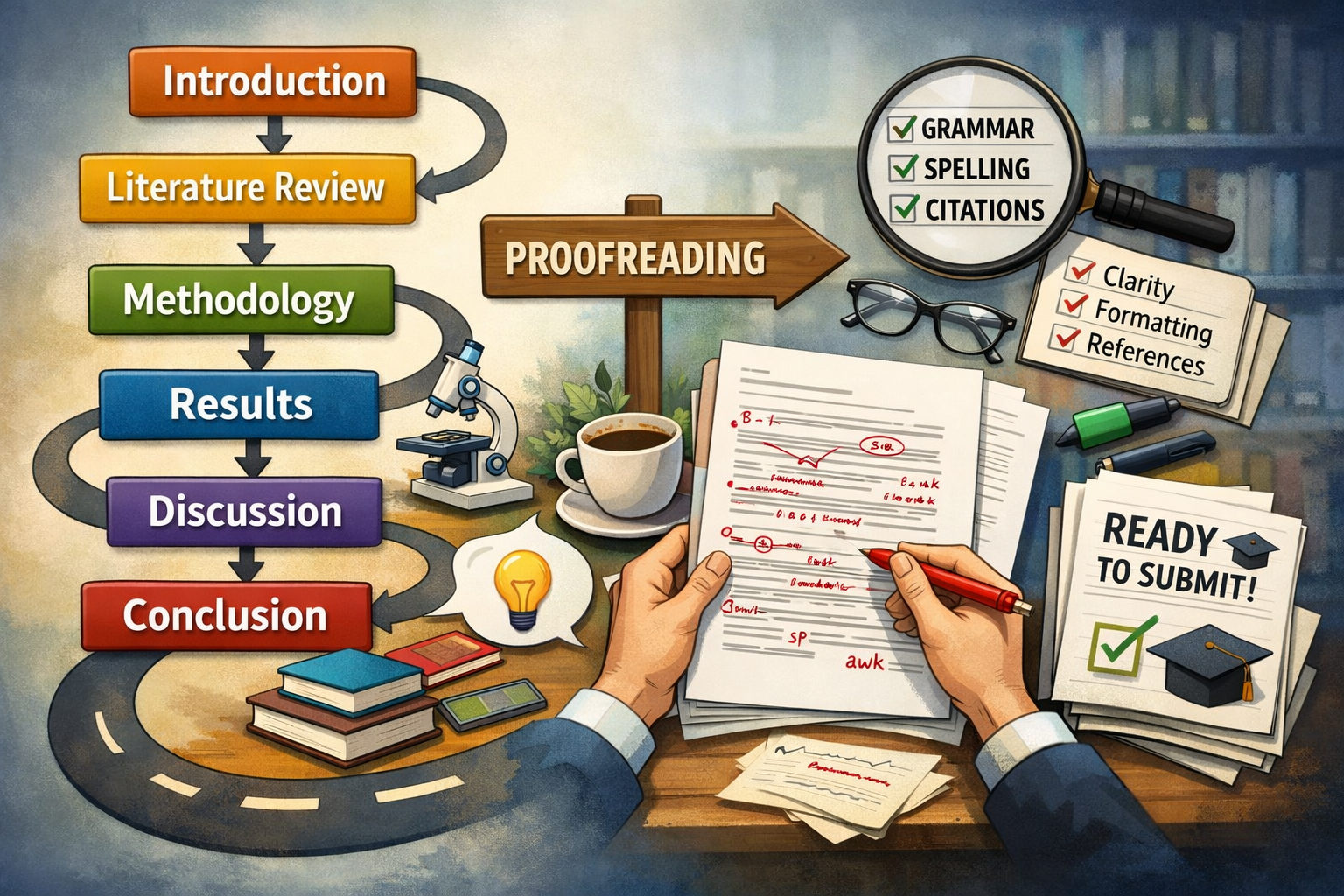
A dissertation typically follows a clear structure:
Introduction
Literature Review
Methodology
Results
Discussion
Conclusion
Each chapter should build upon the previous one while maintaining a clear narrative.
Smooth Transitions
Transitions help readers understand how ideas relate. For example:
Linking research questions to literature review findings
Connecting methodology to research objectives
Explaining how results support or challenge existing research
Consistent Argument
Your dissertation should maintain a consistent argument from beginning to end. Each chapter should reinforce your main research question.
Paragraph Coherence
Every paragraph should contain:
A clear topic sentence
Supporting evidence
Analysis or explanation
A transition to the next idea
What is Dissertation Proofreading?
Dissertation proofreading is the final stage of editing where grammar, punctuation, spelling, formatting, and language clarity are carefully checked.
Proofreading ensures that your dissertation is free from errors that could negatively impact your grades or credibility.
Unlike editing, which may involve structural changes, proofreading focuses on polishing the final document.
Key Areas Covered in Dissertation Proofreading
Professional dissertation proofreading typically includes:
Grammar and punctuation correction
Sentence clarity improvement
Spelling error correction
Academic tone adjustments
Citation formatting checks
Consistency in terminology
Table and figure formatting
Reference list verification
Why Dissertation Flow and Proofreading Matter
Students often underestimate the importance of proofreading and flow. Even excellent research can lose credibility if the writing appears disorganized or contains errors.
1. Improves Readability
A well-proofread dissertation is easier to read and understand. Examiners can follow your arguments without confusion.
2. Strengthens Academic Credibility
Clear structure and polished writing demonstrate professionalism and attention to detail.
3. Enhances Argument Quality
Improving dissertation flow ensures that arguments are logically connected.
4. Reduces Risk of Revisions
Many dissertations are returned for corrections due to poor formatting, grammar mistakes, or unclear structure.
5. Improves Grades
Universities evaluate dissertations not only on research quality but also on clarity and presentation.
Common Problems in Dissertation Flow
Many dissertations struggle with flow issues such as:
Weak Chapter Transitions
Chapters sometimes feel disconnected. For example, the methodology chapter may not clearly link to research objectives.
Repetition of Ideas
Students often repeat similar arguments in different sections without adding new insights.
Poor Paragraph Organization
Long paragraphs without clear structure make the dissertation difficult to follow.
Inconsistent Terminology
Using different terms for the same concept can confuse readers.
How Dissertation Proofreading Improves Flow
Proofreading is not only about correcting grammar. It also helps improve the logical structure of your dissertation.
Identifying Structural Gaps
Proofreaders can detect sections where arguments are incomplete or poorly explained.
Improving Sentence Clarity
Complex sentences can be simplified for better readability.
Enhancing Transitions
Adding linking phrases improves continuity between ideas.
Ensuring Consistency
Proofreading ensures consistent use of terminology, citations, and formatting.
Dissertation Proofreading Checklist
Before submitting your dissertation, use this proofreading checklist.
Grammar and Language
Check for grammar mistakes
Correct punctuation errors
Remove unnecessary words
Ensure academic tone
Structure and Flow
Verify logical sequence of chapters
Improve transitions between paragraphs
Ensure arguments support research questions
Formatting
Confirm font and spacing guidelines
Check headings and subheadings
Verify table and figure formatting
Citations and References
Ensure citation style consistency (APA, Harvard, MLA)
Confirm all references are included
Check in-text citation accuracy
Spelling and Typographical Errors
Even small spelling mistakes can affect professionalism.
Tools for Dissertation Proofreading
Several tools can help improve dissertation proofreading:
Grammarly
Helps identify grammar mistakes and improve sentence clarity.
Hemingway Editor
Improves readability and highlights complex sentences.
Turnitin
Checks for plagiarism and citation accuracy.
Microsoft Word Editor
Provides grammar suggestions and formatting checks.
While tools are useful, they cannot replace human proofreading.
Professional Dissertation Proofreading Services
Many students choose professional proofreading services to ensure their dissertations meet university standards.
Benefits of Professional Proofreading
Expert Academic Editors
Professional proofreaders understand academic writing standards.
Improved Clarity and Flow
Editors improve transitions and logical structure.
Time Saving
Students can focus on research while experts polish the writing.
Formatting Accuracy
Professionals ensure compliance with university formatting guidelines.
Higher Quality Submission
A polished dissertation leaves a strong impression on examiners.
Tips for Improving Dissertation Flow
Here are practical strategies to enhance dissertation flow.
Create a Clear Outline
An outline helps organize ideas before writing.
Use Topic Sentences
Each paragraph should begin with a sentence summarizing its main idea.
Use Linking Words
Examples include:
Furthermore
However
Therefore
In contrast
Consequently
Avoid Long Sentences
Shorter sentences improve readability.
Read Your Dissertation Aloud
Reading aloud helps identify awkward phrasing and flow problems.
When to Proofread Your Dissertation
Proofreading should occur in several stages.
After Completing Each Chapter
Early proofreading helps prevent accumulation of errors.
After Full Draft Completion
Review the entire dissertation for structural consistency.
Before Final Submission
Conduct a final proofreading check for grammar and formatting.
Dissertation Editing vs Dissertation Proofreading
Many students confuse editing with proofreading.
Dissertation Editing
Improves structure
Strengthens arguments
Rewrites unclear sections
Enhances academic tone
Dissertation Proofreading
Corrects grammar errors
Fixes spelling mistakes
Adjusts punctuation
Ensures formatting accuracy
Both processes are important for producing a high-quality dissertation.
Dissertation Flow Examples
To understand dissertation flow, consider this simple example:
Poor Flow Example
“The study examines student performance. Many researchers have studied education systems. Data was collected from surveys.”
These sentences feel disconnected.
Improved Flow Example
“This study examines student performance in higher education. Previous research on education systems highlights several factors influencing academic success. Building on this literature, data was collected through student surveys.”
The second example demonstrates improved logical progression.
Final Dissertation Proofreading Tips
Before submitting your dissertation, follow these final tips:
Take a break before proofreading
Print your dissertation to review it differently
Check references carefully
Review formatting guidelines from your university
Ask a peer or mentor to review your work
Conclusion
Achieving strong dissertation flow and conducting thorough dissertation proofreading are essential steps in producing a successful academic dissertation. A well-structured dissertation guides readers through your research logically, while careful proofreading eliminates errors and enhances professionalism.
By focusing on smooth transitions, consistent arguments, and polished writing, students can significantly improve the quality of their dissertations. Whether using proofreading tools, peer reviews, or professional services, investing time in dissertation flow and proofreading will ultimately lead to a clearer, more impactful academic submission.