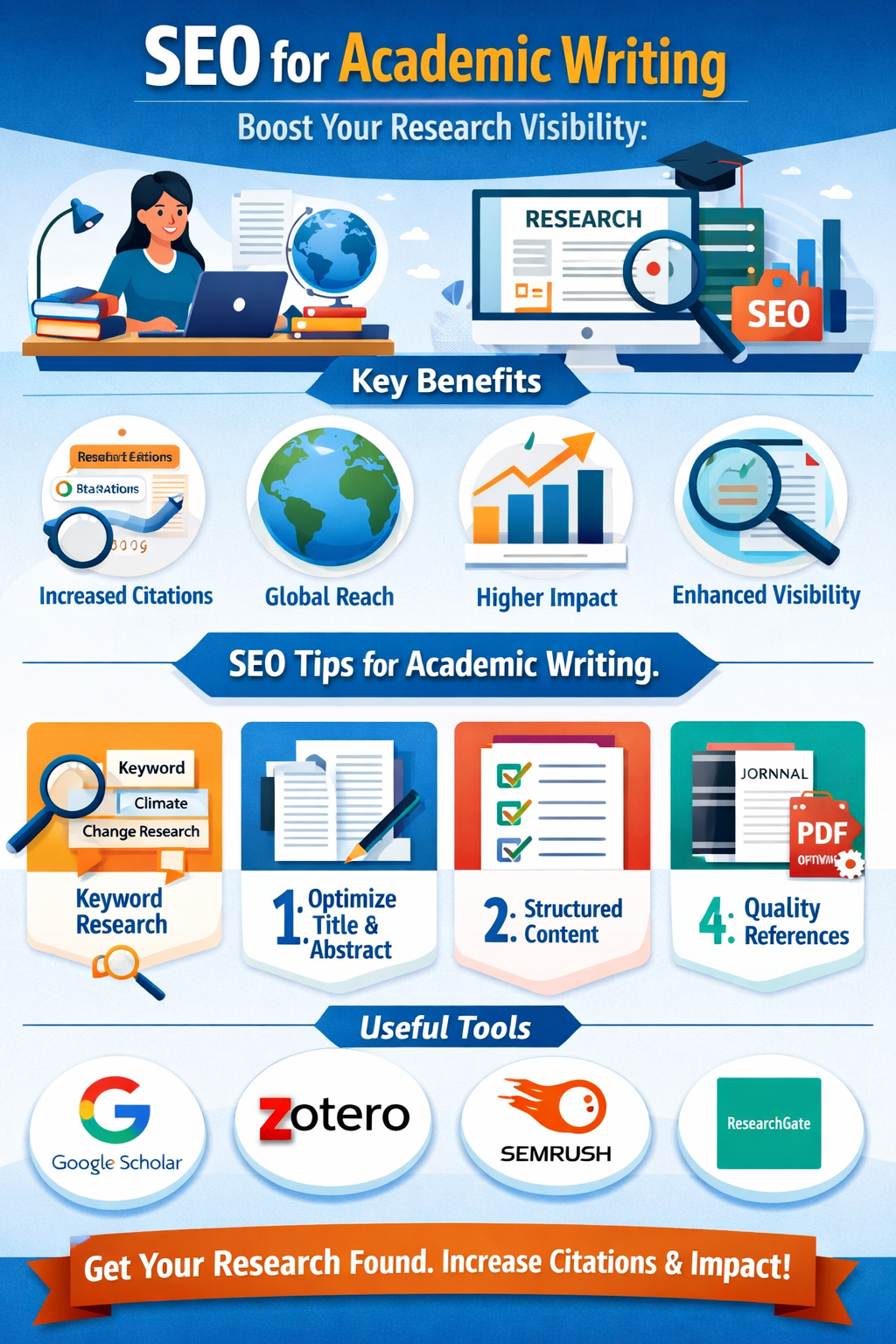
SEO for Academic Writing: Boost Your Research Visibility
In the digital age, academic writing is not just about publishing insightful research; it’s also about ensuring your work reaches the right audience. This is where SEO for academic writing comes in. By optimizing your research papers, theses, and articles for search engines, you can increase visibility, citations, and overall impact.
What is SEO for Academic Writing?
SEO (Search Engine Optimization) for academic writing involves using targeted keywords, metadata, and structured content to make your research more discoverable online. Unlike traditional SEO for blogs or e-commerce, academic SEO focuses on scholarly content, research repositories, and educational databases.
Key aspects include:
Using relevant academic keywords in your title, abstract, and headings.
Structuring your content with subheadings, bullet points, and tables for readability.
Including high-quality references and backlinks to reputable sources.
Optimizing PDFs and journal pages for search engines.
Benefits of SEO in Academic Writing
Increased Citations: Optimized research is more likely to be found and cited by peers.
Global Reach: SEO ensures your work reaches a wider international audience.
Higher Academic Impact: Search-friendly research can enhance your reputation and opportunities for collaboration.
Enhanced Online Presence: Proper SEO improves visibility in Google Scholar, ResearchGate, and institutional repositories.
How to Implement SEO for Academic Writing
1. Conduct Keyword Research
Identify keywords your target audience is searching for. For example, if your paper is about climate change, include terms like “climate change research 2026”, “environmental impact studies”, or “climate science paper”.
2. Optimize Your Title and Abstract
Your title should be clear, concise, and contain your primary keyword. Abstracts should include secondary keywords naturally, summarizing the research while being search-friendly.
3. Use Structured Content
Break down your paper using headings (H1, H2, H3) and bullet points. This improves readability for both humans and search engines.
4. Reference Quality Sources
Citations from high-authority journals and websites increase trustworthiness, which positively affects SEO rankings.
5. Optimize Online Formats
Ensure your PDFs and online publications are SEO-friendly by using searchable text, descriptive filenames, and metadata tags.
6. Promote Your Research
Share your work on academic networks, social media, and blogs. Backlinks from reputable sources strengthen your SEO authority.
Tools to Help with Academic SEO
Google Scholar Metrics – Track citation impact.
Zotero or Mendeley – Manage references and improve linking.
Yoast SEO – For academic blogs and online articles.
Semrush / Ahrefs – For keyword research tailored to academic niches.
Conclusion
Integrating SEO for academic writing is no longer optional. It enhances the discoverability, credibility, and impact of your research. By applying SEO strategies, you can ensure your work reaches the right audience and contributes meaningfully to your field.
SEO for Academic Writing: Strategies to Boost Your Research Visibility
In the digital era, publishing academic research is only the first step. Ensuring that your work is discoverable online is equally important. This is where SEO for academic writing becomes crucial. By optimizing your research papers, dissertations, and articles for search engines, you can increase visibility, attract citations, and make a real impact in your field.
Whether you are a student, researcher, or academic professional, understanding SEO can transform how your work reaches audiences.
What is SEO for Academic Writing?
SEO, or Search Engine Optimization, is the process of making content easier to find on search engines like Google, Bing, and Google Scholar. When applied to academic writing, it involves optimizing research papers, theses, and journal articles to appear higher in search results, ensuring your research reaches the right readers.
Academic SEO differs from general SEO because it focuses on:
Academic databases (e.g., Google Scholar, ResearchGate, JSTOR)
Research-specific keywords
Citations and references
Structured, formal writing styles
By integrating SEO principles into academic writing, your work gains more visibility, potentially leading to higher citations, collaborations, and global recognition.
Why SEO is Essential in Academic Writing
Academic research is valuable only if it reaches the people who can use it. SEO helps ensure that your work does not remain hidden in digital archives. Key benefits include:
Increased Citations
Papers optimized with SEO strategies are easier to discover and cite. This can significantly improve your academic reputation and career progression.Wider Audience Reach
SEO helps your work reach international readers, fellow researchers, and interdisciplinary scholars who might otherwise miss your research.Enhanced Academic Impact
Search engine visibility can boost the influence of your research, making it a reference point for future studies.Better Online Presence
Optimized research enhances your professional profile on platforms like Google Scholar, ResearchGate, and institutional repositories.
Key SEO Strategies for Academic Writing
1. Keyword Research
The foundation of SEO is keyword research. Identify terms your target audience is searching for. Use a mix of:
Primary keywords: Main topic of your research (e.g., “climate change adaptation strategies”)
Secondary keywords: Related concepts or subtopics (e.g., “sustainable agriculture practices”)
Long-tail keywords: Detailed phrases that match search intent (e.g., “impact of climate change on small-scale farming in Kenya”)
Tools for academic keyword research:
Google Scholar – Analyze top papers in your field and their keywords.
Semrush / Ahrefs – Discover trending academic search terms.
Zotero / Mendeley – Find keyword patterns in references.
2. Optimize Your Title and Abstract
Your title is the first thing search engines and readers notice. Ensure it is:
Clear, concise, and contains your primary keyword
Informative, highlighting the main topic and purpose
Not overloaded with jargon
Example:
Poor: “A Study on Climate Issues”
Optimized: “Climate Change Adaptation Strategies for Small-Scale Farming in Sub-Saharan Africa”
Your abstract should also include primary and secondary keywords naturally while summarizing your research clearly.
3. Use Structured Content
Breaking your paper into sections and subheadings improves readability and SEO. Use:
H1 for the main title
H2 for main sections (Introduction, Methods, Results, Discussion)
H3 for subsections or detailed points
Bullet points or numbered lists to organize information
Search engines favor structured content because it’s easier to index and understand.
4. Reference High-Quality Sources
Citations from credible academic journals and authoritative websites increase trustworthiness, which positively affects SEO. Include:
Peer-reviewed journals
Books from recognized publishers
Reputable online databases
Tip: Linking to your previous publications can improve both SEO and your citation network.
5. Optimize PDFs and Online Formats
Many academic papers are shared as PDFs. To make them SEO-friendly:
Ensure text is searchable, not scanned images
Use descriptive filenames (e.g., climate_change_farming_Kenya.pdf)
Add metadata: title, author, keywords, abstract
This ensures search engines index your PDF properly and improves discoverability.
6. Promote Your Research Online
Sharing your research increases backlinks and visibility. Consider:
ResearchGate or Academia.edu for academic networking
Social media: Twitter, LinkedIn, and academic discussion groups
University or personal blogs with summaries of your research
Backlinks from high-authority websites enhance SEO credibility and boost rankings in search engines.
Tools and Techniques to Enhance Academic SEO
| Tool | Purpose | How to Use |
|---|---|---|
| Google Scholar Metrics | Track citation impact | Monitor which keywords bring traffic to your papers |
| Zotero / Mendeley | Reference management | Organize sources and identify popular keywords |
| Yoast SEO | Content optimization | Optimize blog or online article versions of academic content |
| Semrush / Ahrefs | Keyword research | Find trending topics and long-tail keywords in your niche |
Common Mistakes in Academic SEO
Keyword Stuffing – Overusing keywords reduces readability and SEO value.
Ignoring Metadata – Missing metadata can prevent search engines from indexing your work.
Poor PDF Optimization – Non-searchable PDFs limit visibility.
Neglecting Promotion – Publishing without promoting your research reduces its potential reach.
Examples of SEO in Academic Writing
Case Study 1: A 2025 study on renewable energy in Africa increased citations by 40% after optimizing keywords in titles, abstracts, and metadata.
Case Study 2: An environmental science blog with research summaries boosted Google Scholar visibility by implementing structured headings and backlinks.
FAQs About SEO for Academic Writing
Q1: Can students use SEO for thesis papers?
Yes, optimizing your thesis with keywords and structured content can improve online visibility if it’s shared in open-access repositories.
Q2: Is SEO ethical in academic writing?
Yes, as long as you don’t manipulate results or misrepresent research. SEO simply helps readers discover your work.
Q3: How long does it take to see SEO results?
It varies. Academic SEO benefits often appear over months as citations and online visibility grow.
Q4: Do journals care about SEO?
Top journals prioritize quality research, but SEO can help your article reach more readers post-publication.
Conclusion
SEO for academic writing is a powerful tool to enhance research visibility, impact, and citations. By applying keyword research, structured content, high-quality references, and strategic promotion, researchers can ensure their work reaches the right audience and contributes meaningfully to their field.