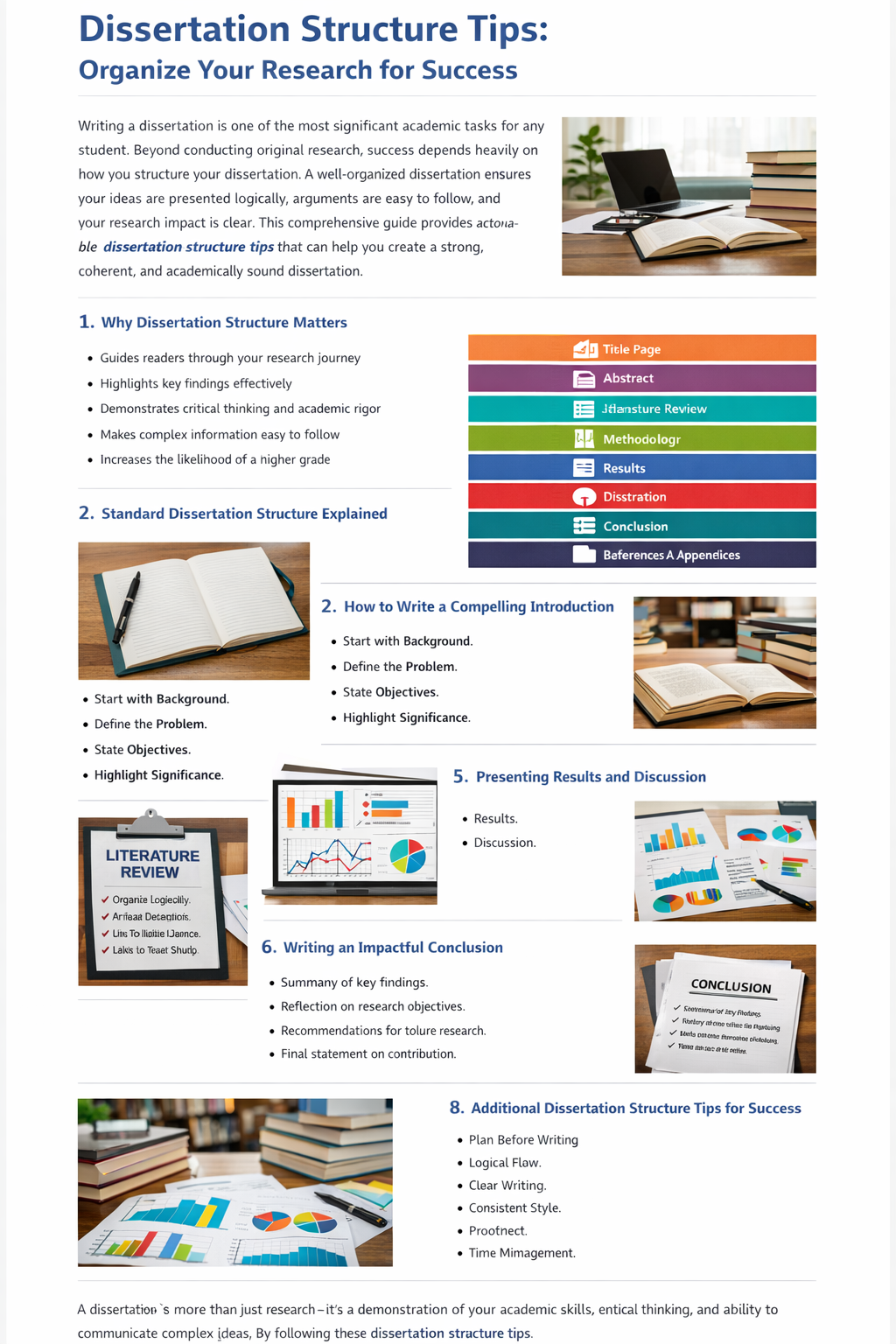
Dissertation Structure Tips: How to Organize Your Research for Success
Writing a dissertation is one of the most significant academic tasks for any student. Beyond conducting original research, success depends heavily on how you structure your dissertation. A well-organized dissertation ensures your ideas are presented logically, arguments are easy to follow, and your research impact is clear. This comprehensive guide provides actionable dissertation structure tips that can help you create a strong, coherent, and academically sound dissertation.
Why Dissertation Structure Matters
Before diving into structure tips, it’s essential to understand why structure is critical. A dissertation isn’t just about presenting research—it’s about telling a story of inquiry. Proper structure:
Guides readers through your research journey
Highlights key findings effectively
Demonstrates critical thinking and academic rigor
Makes complex information easy to follow
Increases the likelihood of a higher grade
By following a standard structure and implementing these tips, you create a polished dissertation that communicates your work clearly and professionally.
1. Standard Dissertation Structure Explained
Most universities require dissertations to follow a conventional format. While slight variations exist depending on the field, the typical structure includes:
Title Page
Contains your dissertation title, name, institution, department, degree, and submission date.
Tip: Keep the title concise, informative, and reflective of your research focus.
Abstract
A summary of your research objectives, methods, findings, and conclusions in 150–300 words.
Tip: Write this last to ensure it reflects the full content of your dissertation.
Acknowledgements (Optional)
Recognize supervisors, colleagues, or anyone who helped during your research.
Table of Contents
Lists all chapters, sections, and page numbers.
Tip: Use automated tools in Word or Google Docs to generate it dynamically.
Introduction
Introduces your topic, research problem, objectives, and research questions.
Explains the significance of your study.
Tip: Keep it clear and concise; avoid in-depth analysis here.
Literature Review
Analyzes existing studies and identifies gaps in research.
Organize by theme, theory, or chronological order.
Tip: Focus on critical evaluation rather than mere description.
Methodology
Explains research design, data collection, and analysis methods.
Tip: Justify why you chose your methods and how they address your research questions.
Results / Findings
Presents your data using tables, graphs, and narrative explanations.
Tip: Be objective and clear; avoid interpreting results here.
Discussion
Interprets your findings, linking them to research questions and literature.
Highlights the implications and significance of your results.
Conclusion & Recommendations
Summarizes key findings and their contribution to the field.
Provides suggestions for future research or practical applications.
References / Bibliography
Lists all sources used in your research.
Tip: Follow your university’s required citation style (APA, Harvard, MLA, etc.).
Appendices
Include supplementary material such as surveys, raw data, or interview transcripts.
2. How to Write a Compelling Introduction
The introduction sets the tone for your dissertation. Use these structure tips:
Start with Background: Introduce the research area and its relevance.
Define the Problem: Clearly state the research problem or gap.
State Objectives: Present clear research aims and questions.
Highlight Significance: Explain why your study is important to the field.
Pro Tip: Avoid including detailed findings here. Save explanations for later chapters.
3. Crafting a Strong Literature Review
The literature review demonstrates your understanding of the field. Key tips include:
Organize Logically: Use thematic, theoretical, or chronological organization.
Critical Evaluation: Don’t just summarize—analyze strengths, weaknesses, and gaps in research.
Use Reliable Sources: Focus on peer-reviewed journals, books, and credible studies.
Link to Your Study: Highlight how your research addresses gaps identified in the literature.
SEO Tip: Use variations like “how to structure a literature review” or “literature review tips” naturally throughout the text.
4. Writing the Methodology Section
The methodology explains how you conducted your research. Include:
Research Design: Qualitative, quantitative, or mixed-methods.
Sampling: Describe population, sample size, and selection techniques.
Data Collection: Surveys, interviews, experiments, or secondary data.
Data Analysis: Explain statistical methods, coding techniques, or analytical frameworks.
Dissertation Structure Tip: Subheadings improve readability and make it easier for readers to locate specific methods.
5. Presenting Results and Discussion
Results: Present data clearly using charts, tables, and figures. Avoid interpretation here.
Discussion: Explain what your results mean, compare them with existing literature, and discuss implications.
Pro Tip: Keep results and discussion separate to maintain clarity. Use headings and subheadings for organization.
6. Writing an Impactful Conclusion
The conclusion ties your research together. Include:
Summary of key findings
Reflection on research objectives and questions
Recommendations for practice, policy, or further research
Final statement on the study’s contribution
Tip: End with a strong, memorable statement that emphasizes the importance of your work.
7. Formatting, References, and Appendices
Use consistent heading styles for chapters and sub-sections.
Follow citation rules strictly to avoid plagiarism.
Include page numbers, figure captions, and table titles.
Appendices should contain only supplementary material that supports the main text.
SEO Tip: Include phrases like “dissertation formatting tips” and “how to reference a dissertation” to increase search relevance.
8. Additional Dissertation Structure Tips for Success
Plan Before Writing: Outline each chapter and sub-section.
Logical Flow: Ensure ideas progress naturally from introduction to conclusion.
Clear Writing: Avoid jargon, write concisely, and use active voice where possible.
Consistent Style: Use the same tense, formatting, and citation style throughout.
Proofread: Check grammar, spelling, and clarity. Seek supervisor feedback.
Time Management: Allocate sufficient time for planning, writing, and revision.
9. Common Mistakes to Avoid
Poor chapter organization
Mixing results and discussion
Overloading with unnecessary information
Ignoring formatting and citation rules
Weak conclusions without clear research contribution
Avoiding these mistakes ensures your dissertation is professional, readable, and academically sound.
10. Final Thoughts
A dissertation is more than just research—it’s a demonstration of your academic skills, critical thinking, and ability to communicate complex ideas. By following these dissertation structure tips, you can produce a document that is:
Well-organized and logically structured
Easy to read and navigate
Academically rigorous and credible
Optimized for maximum impact
Remember, structure is the backbone of your dissertation. Start early, plan each section carefully, and refine your work continuously. With these tips, you’re well on your way to a successful dissertation submission.
Writing a dissertation can be overwhelming, especially when it comes to structuring your work. A well-organized dissertation not only improves readability but also enhances the clarity of your research. This guide provides essential dissertation structure tips to help you present your ideas logically and meet academic standards.
1. Understand the Standard Dissertation Structure
Most dissertations follow a common structure, which includes:
Title Page: Clearly state your research title, name, institution, and date.
Abstract: Summarize your research objectives, methods, findings, and conclusions in 150–300 words.
Acknowledgements: Optional section to thank contributors and supervisors.
Table of Contents: List all chapters, sections, and page numbers.
Introduction: Introduce your research topic, objectives, and rationale.
Literature Review: Analyze existing research, identify gaps, and justify your study.
Methodology: Explain your research design, methods, and data collection techniques.
Results / Findings: Present your research outcomes using tables, charts, or narratives.
Discussion: Interpret your results and relate them to existing literature.
Conclusion & Recommendations: Summarize key insights, highlight contributions, and suggest future research.
References / Bibliography: List all sources in the required citation style.
Appendices: Include supplementary material like questionnaires or raw data.
2. Start with a Strong Introduction
A clear introduction sets the tone for your dissertation. Include:
Background of your topic
Research problem and questions
Objectives and hypotheses
Significance of the study
Tip: Keep it concise but informative. Avoid unnecessary details that belong in later chapters.
3. Master the Literature Review
The literature review demonstrates your understanding of the research field. Dissertation structure tips for this section:
Organize by themes, theories, or chronology.
Critically analyze, don’t just summarize.
Highlight research gaps your study will address.
4. Clearly Define Your Methodology
Your methodology explains how you conducted your research. Include:
Research design (qualitative, quantitative, or mixed-methods)
Sampling techniques and population
Data collection tools
Data analysis methods
Tip: Use subheadings for each method to make it easier to read.
5. Present Results and Discussion Effectively
Results: Use charts, graphs, and tables to present data clearly.
Discussion: Interpret results, link them to research questions, and compare with existing literature.
Dissertation structure tip: Avoid mixing results with discussion—keep them in separate sections for clarity.
6. Conclude with Impact
The conclusion should:
Summarize key findings
Reflect on research objectives
Provide recommendations for practice or future research
Tip: End with a strong statement about your study’s contribution to the field.
7. Formatting and References
Use consistent headings and subheadings.
Follow your university’s citation style strictly (APA, MLA, Harvard, etc.).
Include page numbers, figure numbers, and tables correctly.
Bonus Dissertation Structure Tips
Plan your chapters before writing.
Maintain logical flow from one section to another.
Use clear and concise language.
Proofread thoroughly and get feedback from your supervisor.
Conclusion
A well-structured dissertation is key to academic success. By following these dissertation structure tips, you can organize your research effectively, present arguments clearly, and achieve a high-quality final document. Start planning early, write systematically, and review your structure regularly to ensure your dissertation stands out.