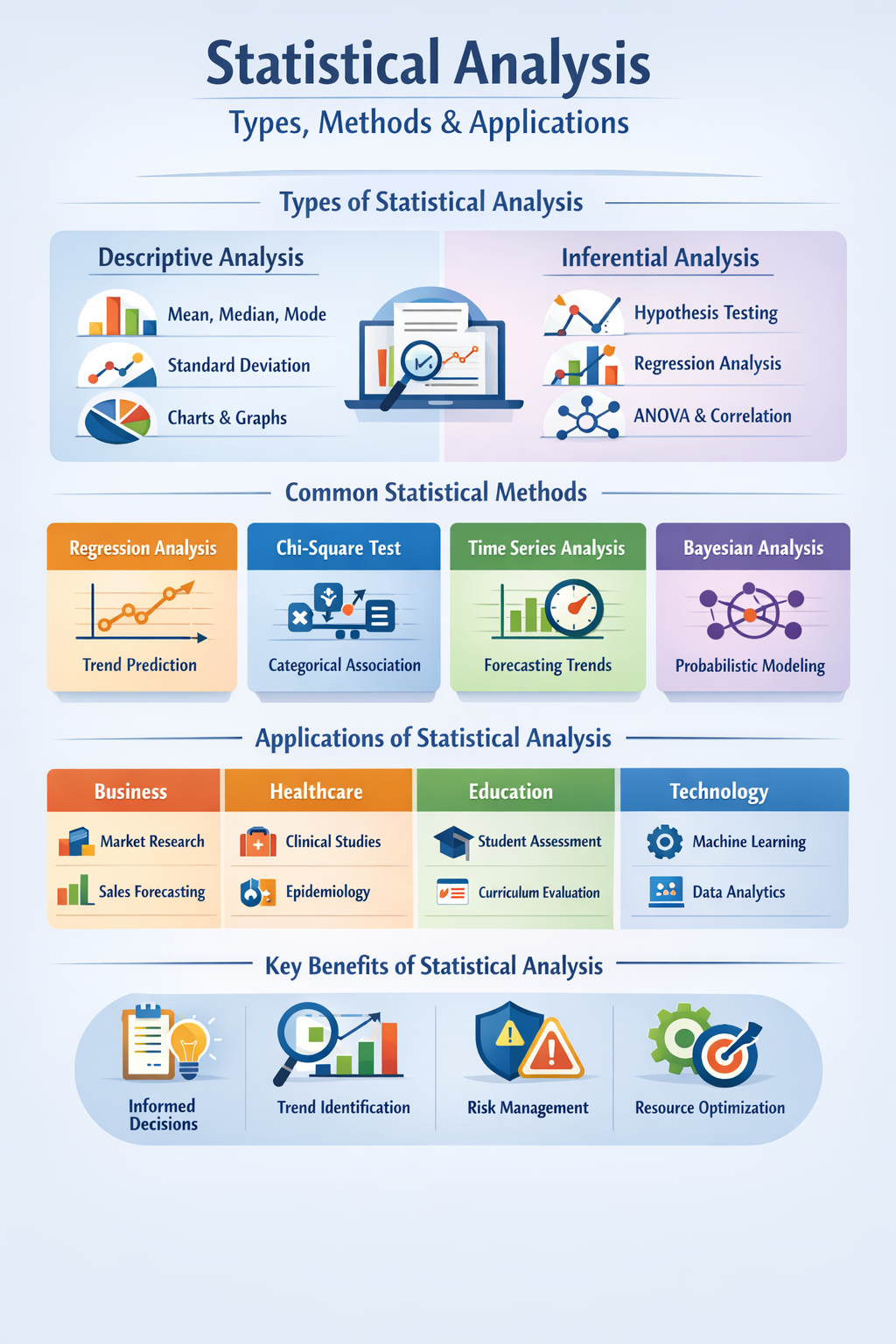
What is Statistical Analysis?
Statistical analysis is more than just numbers—it’s a critical skill for extracting meaningful insights from data. By applying descriptive and inferential techniques, professionals can identify trends, make predictions, and drive impactful decisions.
Mastering statistical analysis is essential in a data-driven world, ensuring that conclusions are not only accurate but also actionable.
Introduction to Statistical Analysis
Statistical analysis is the systematic process of exploring, interpreting, and summarizing data to identify patterns, relationships, and trends. It is a cornerstone of modern research and business intelligence, enabling professionals to make data-driven decisions.
Whether in finance, healthcare, or technology, statistical analysis helps turn raw data into actionable insights, reduce uncertainty, and optimize strategies.
Long-tail keywords for SEO: “importance of statistical analysis,” “statistical analysis in research,” “benefits of statistical analysis.”
Types of Statistical Analysis
Understanding the types of statistical analysis is key to applying the right method for your data. There are two main categories:
1. Descriptive Statistical Analysis
Descriptive analysis summarizes data to understand its basic characteristics. Common techniques include:
Measures of Central Tendency: Mean, median, and mode show the average or typical value.
Measures of Dispersion: Range, variance, and standard deviation illustrate data variability.
Frequency Distribution: Organizes data to highlight patterns and trends.
Visualization Tools: Graphs, charts, and histograms make data easier to interpret.
Example: A school analyzing students’ test scores might use descriptive statistics to find the average score and identify performance trends.
2. Inferential Statistical Analysis
Inferential statistics uses sample data to make conclusions about a larger population. Techniques include:
Hypothesis Testing: Determines whether assumptions about data are valid.
Regression Analysis: Evaluates relationships between variables to make predictions.
Correlation Analysis: Measures the strength and direction of relationships.
ANOVA (Analysis of Variance): Compares multiple groups to detect significant differences.
Example: A company might use inferential statistical analysis to predict future sales based on a sample of customer purchase data.
Common Statistical Methods and Techniques
Here are widely used statistical methods in research and business:
| Method | Description | Use Case |
|---|---|---|
| Regression Analysis | Predicts a dependent variable based on independent variables | Sales forecasting |
| Time Series Analysis | Analyzes data over time to identify trends | Stock market trends |
| Chi-Square Test | Tests the relationship between categorical variables | Survey analysis |
| Factor Analysis | Reduces large datasets to key factors | Customer behavior segmentation |
| Bayesian Analysis | Updates predictions using probability as new data emerges | Predictive modeling |
These techniques form the backbone of quantitative research and decision-making across industries.
Applications of Statistical Analysis
Statistical analysis has versatile applications:
Business & Marketing:
Market research and customer segmentation
Sales forecasting and trend prediction
Performance evaluation of marketing campaigns
Healthcare & Medicine:
Clinical trials and treatment efficacy studies
Epidemiology and population health analysis
Risk assessment for patient outcomes
Education:
Analyzing student performance
Curriculum evaluation
Educational research studies
Social Sciences:
Studying social behaviors and population trends
Policy evaluation
Survey data analysis
Technology & Data Science:
Machine learning model development
Algorithm optimization
Predictive analytics
Why Statistical Analysis is Essential
Evidence-Based Decisions: Enables organizations to act on reliable data.
Trend Identification: Detects patterns and insights not visible in raw data.
Risk Management: Identifies potential risks and opportunities.
Resource Optimization: Improves efficiency through data-driven strategies.
In a world driven by data, statistical analysis is indispensable for accuracy, reliability, and strategic planning.
Tools and Software for Statistical Analysis
SPSS: Popular among social science researchers.
R & Python: Powerful programming languages for complex statistical modeling.
Excel: Accessible tool for basic data analysis and visualization.
SAS: Enterprise-level analytics and reporting.
Tableau & Power BI: Advanced visualization and business intelligence tools.
Choosing the right tool depends on data complexity, analysis needs, and technical expertise.
Tips for Effective Statistical Analysis
Understand Your Data: Know the type, distribution, and limitations.
Choose the Right Method: Match your statistical technique to your research goal.
Visualize Results: Graphs and charts improve comprehension and reporting.
Validate Findings: Use hypothesis testing and confidence intervals to confirm results.
Keep Data Clean: Accurate input ensures reliable analysis.
Conclusion
Statistical analysis is more than just number-crunching—it is a powerful approach to understanding and leveraging data. By mastering descriptive and inferential techniques, professionals across industries can make informed decisions, predict trends, and optimize outcomes.
Whether for research, business, or technology, proficiency in statistical analysis is an invaluable skill in today’s data-driven world.
Introduction: What is Statistical Analysis?
Whether in research, business, healthcare, or technology, mastering statistical analysis ensures that decisions are accurate, evidence-based, and actionable.