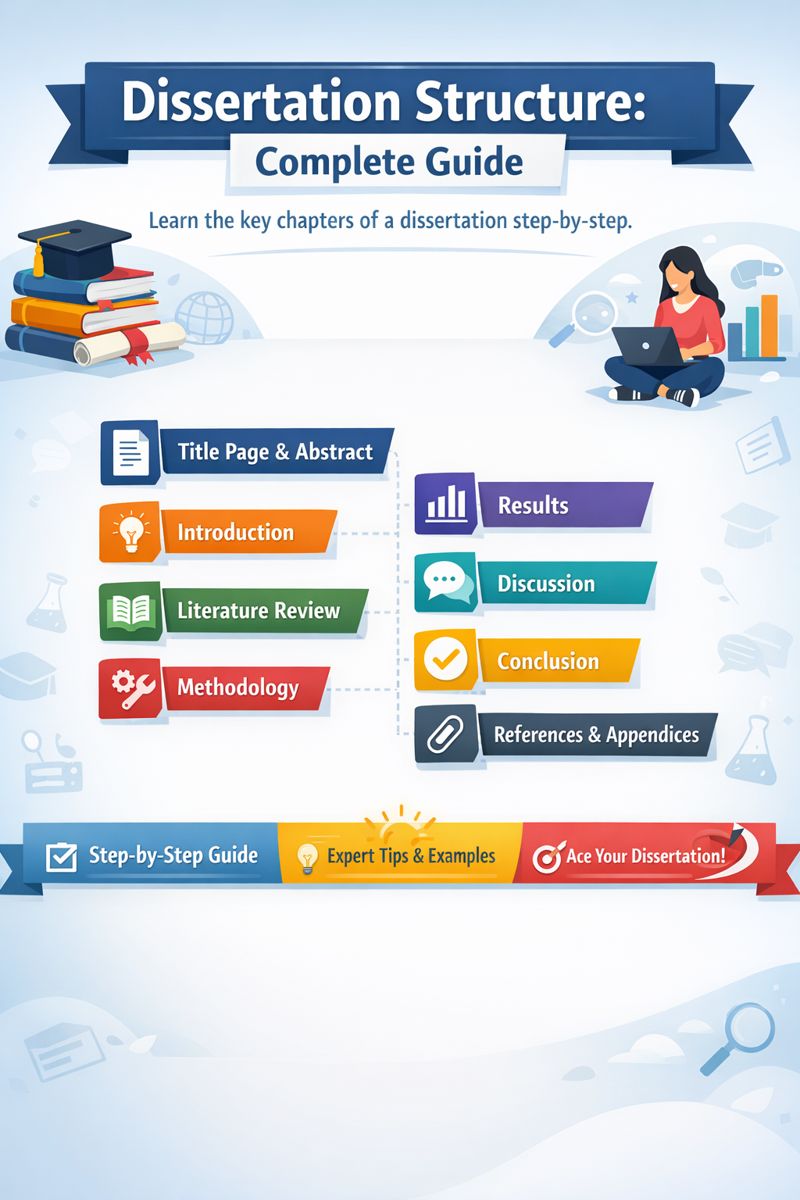
Dissertation Structure: A Complete Guide (With Examples)
When writing a dissertation, structure matters more than you think. A clear dissertation structure helps you organize your research, communicate your findings effectively, and meet university requirements.
If you want a strong dissertation, you must follow a standard structure that includes key sections such as Introduction, Literature Review, Methodology, Results, Discussion, and Conclusion.
📌 What Is Dissertation Structure?
Dissertation structure refers to the organization and layout of a dissertation document. It includes all the essential sections that must appear in a dissertation to make it coherent, logical, and academically acceptable.
A well-structured dissertation ensures:
Smooth flow of ideas
Clear presentation of research
Proper argument development
Easy navigation for examiners
✅ Standard Dissertation Structure (Most Universities)
Here is the most common dissertation structure used in universities worldwide:
1. Title Page
Dissertation title
Student name
University name
Course name
Submission date
2. Abstract
A brief summary of the whole dissertation (usually 250–300 words).
Includes:
Research aim
Methods
Key findings
Conclusion
3. Acknowledgements
Thank those who supported your research (optional but recommended).
4. Table of Contents
List of chapters, sections, and page numbers.
5. Introduction
This chapter introduces your topic and includes:
Background of the study
Research problem
Objectives
Research questions
Scope and limitations
6. Literature Review
A detailed review of existing research.
It shows:
What is already known
Research gaps
Theoretical framework
7. Methodology
Explains how the research was conducted.
Includes:
Research design
Data collection methods
Sampling techniques
Data analysis methods
8. Results
Presents findings clearly using:
Tables
Charts
Graphs
Descriptive text
9. Discussion
Interpretation of results and linking them to literature.
Discuss:
What the results mean
How they support or contradict previous research
Implications
10. Conclusion
Summarize the entire study.
Includes:
Main findings
Recommendations
Future research areas
11. References
List of all sources cited using Harvard, APA, or MLA style.
12. Appendices
Extra materials like questionnaires, raw data, or interview transcripts.
📌 Dissertation Structure Example (Short Version)
Here’s a quick example of how a dissertation structure looks:
Chapter 1 – Introduction
Chapter 2 – Literature Review
Chapter 3 – Methodology
Chapter 4 – Results
Chapter 5 – Discussion & Conclusion
🔍 Tips for a Strong Dissertation Structure
✔ Follow your university guidelines
✔ Use clear headings and subheadings
✔ Make sure each chapter flows logically
✔ Use consistent referencing style
✔ Avoid irrelevant content
📌 Final Thoughts
A good dissertation structure is the foundation of a successful research project. It makes your work readable, professional, and academically strong. If you follow the standard structure and organize your ideas well, you will produce a dissertation that stands out.
📚 Detailed Dissertation Structure (Chapter-by-Chapter)
Below is a deeper look into what each chapter should include.
📌 Chapter 1: Introduction (Detailed)
The introduction sets the tone of your dissertation. It should clearly explain:
What to include:
Background of the study
Problem statement
Research aim and objectives
Research questions
Significance of the study
Scope and limitations
Definition of key terms
Structure of the dissertation
Example:
“This study examines the impact of digital marketing on consumer behavior in Kenya. It aims to analyze the effectiveness of social media advertising among young adults…”
📌 Chapter 2: Literature Review (Detailed)
The literature review shows your understanding of previous research.
What to include:
Key theories and concepts
Review of past studies
Identify research gaps
Build a theoretical framework
Develop a conceptual framework
Example Structure:
Theoretical framework
Empirical review
Research gap
Conceptual model
📌 Chapter 3: Methodology (Detailed)
The methodology explains how the research was conducted.
What to include:
Research design (qualitative, quantitative, or mixed methods)
Sampling methods
Data collection tools (questionnaires, interviews, etc.)
Data analysis techniques (SPSS, thematic analysis, etc.)
Ethical considerations
Reliability and validity
📌 Chapter 4: Results (Detailed)
This chapter presents your findings clearly.
What to include:
Data presentation (tables, charts, graphs)
Key results based on research questions
Statistical analysis (if any)
Summary of findings
📌 Chapter 5: Discussion (Detailed)
The discussion chapter interprets the results.
What to include:
Interpret results in relation to literature
Explain the meaning of findings
Discuss implications and contributions
Address research questions
📌 Chapter 6: Conclusion and Recommendations
This is the final chapter.
What to include:
Summary of key findings
Conclusion based on research objectives
Recommendations for practice
Suggestions for future research
✅ Dissertation Structure Example (Full Outline)
Here’s a complete example outline:
Title Page
Abstract
Acknowledgements
Table of Contents
Chapter 1 – Introduction
Chapter 2 – Literature Review
Chapter 3 – Methodology
Chapter 4 – Results
Chapter 5 – Discussion
Chapter 6 – Conclusion & Recommendations
References
Appendices
🔍 Common Dissertation Structure Mistakes to Avoid
❌ Missing key chapters
❌ Weak literature review
❌ Unclear research questions
❌ Poor data analysis
❌ No link between findings and literature
❌ Unorganized chapter flow
📌 Dissertation Structure FAQs
Q1: How many chapters should a dissertation have?
Most dissertations have 5 to 6 chapters, but the structure can vary by university and field.
Q2: Can I change the dissertation structure?
Yes, but only if your supervisor allows it. Always follow your university guidelines.
Q3: What is the difference between a dissertation and thesis structure?
They are similar, but a thesis may include more in-depth research and more chapters depending on the academic level.
🚀 Final Thoughts
A strong dissertation structure makes your research clear, professional, and easy to understand. By following this guide, you will be able to write a well-organized dissertation that meets academic standards.