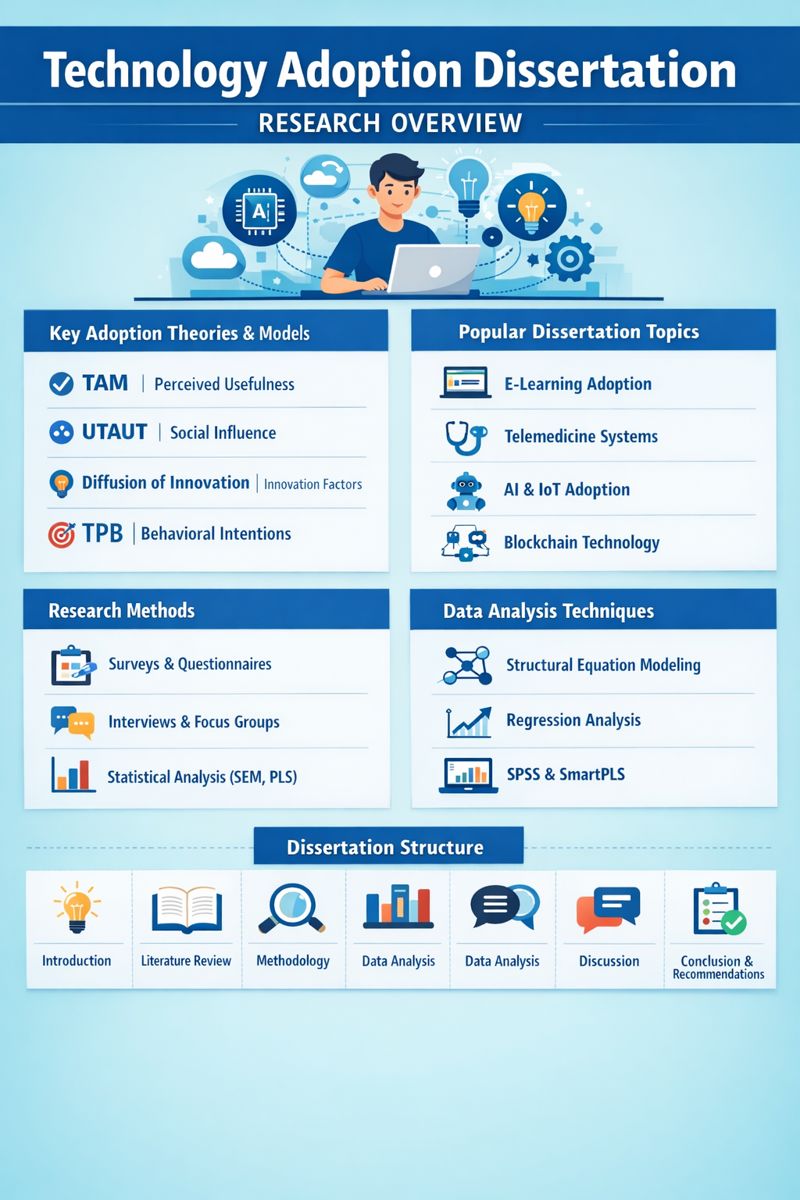
Technology Adoption Dissertation: A Complete Research Guide
A technology adoption dissertation focuses on how individuals, organizations, or societies accept and use new technologies. With rapid digital transformation across education, healthcare, finance, and business, technology adoption has become one of the most researched areas in information systems, management, and social sciences.
This guide explains the concept, key theories, research models, dissertation topics, and methodology to help you develop a high-quality and SEO-relevant technology adoption dissertation.
What Is Technology Adoption?
Technology adoption refers to the process by which users become aware of, evaluate, accept, and integrate new technologies into their daily activities or organizational operations. In academic research, it examines behavioral, organizational, cultural, and technological factors influencing acceptance and usage.
A technology adoption dissertation typically investigates:
User acceptance of digital systems
Barriers and facilitators to technology use
Behavioral intentions and actual usage
Impact of technology on performance and productivity
Importance of Technology Adoption in Dissertation Research
Technology adoption studies are important because they:
Support digital transformation strategies
Improve system design and usability
Help policymakers and businesses make data-driven decisions
Explain resistance to technological change
As emerging technologies like AI, IoT, blockchain, and e-learning platforms expand, technology adoption dissertations remain highly relevant and publishable.
Key Technology Adoption Theories and Models
A strong technology adoption dissertation is built on established theoretical frameworks. The most widely used models include:
1. Technology Acceptance Model (TAM)
TAM focuses on:
Perceived usefulness
Perceived ease of use
It is one of the most cited models in technology adoption dissertation research.
2. Unified Theory of Acceptance and Use of Technology (UTAUT)
UTAUT examines:
Performance expectancy
Effort expectancy
Social influence
Facilitating conditions
3. Diffusion of Innovation Theory (DOI)
Proposed by Rogers, this theory explains adoption based on:
Innovation characteristics
Communication channels
Time
Social systems
4. Theory of Planned Behavior (TPB)
TPB links behavior to:
Attitude
Subjective norms
Perceived behavioral control
5. Extended and Hybrid Models
Many dissertations combine TAM, UTAUT, or TPB with external variables such as trust, risk, security, and organizational culture.
Popular Technology Adoption Dissertation Topics
Choosing the right topic is crucial for originality and SEO relevance. Below are high-impact technology adoption dissertation topics:
General Topics
Factors influencing technology adoption in developing countries
User resistance to new technology adoption
Technology adoption and organizational performance
Business and Management
Adoption of enterprise resource planning (ERP) systems
Cloud computing adoption in small and medium enterprises
Digital payment technology adoption by consumers
Education
Adoption of e-learning platforms in higher education
Factors affecting learning management system adoption
Mobile learning technology adoption among university students
Healthcare
Adoption of telemedicine systems by healthcare professionals
Electronic health record adoption challenges
Technology adoption in digital healthcare transformation
Emerging Technologies
Artificial intelligence adoption in organizations
Blockchain technology adoption in financial institutions
Internet of Things adoption in smart cities
Research Methodology for a Technology Adoption Dissertation
Research Design
Most technology adoption dissertations use:
Quantitative research methods
Cross-sectional survey designs
Some advanced studies apply:
Mixed-methods approaches
Longitudinal analysis
Data Collection
Common data collection methods include:
Online questionnaires
Structured surveys
Interviews and focus groups (for qualitative studies)
Sampling Techniques
Random sampling
Stratified sampling
Convenience sampling (common in student research)
Data Analysis Techniques
Structural Equation Modeling (SEM)
Regression analysis
SPSS, AMOS, or SmartPLS
Structure of a Technology Adoption Dissertation
A standard technology adoption dissertation follows this structure:
Introduction – Research background, problem statement, objectives
Literature Review – Theories, models, and previous studies
Research Methodology – Design, sampling, instruments
Data Analysis and Results – Statistical findings
Discussion – Interpretation of results
Conclusion and Recommendations – Implications and future research
Challenges in Writing a Technology Adoption Dissertation
Students often face:
Selecting the appropriate theoretical model
Designing valid measurement scales
Collecting sufficient responses
Interpreting complex statistical outputs
Early planning and strong alignment between theory, methodology, and objectives help overcome these challenges.
Tips for a High-Quality Technology Adoption Dissertation
Choose a current and relevant technology
Use validated measurement scales
Clearly justify your theoretical framework
Ensure ethical data collection
Link findings to practical implications
Conclusion
A technology adoption dissertation offers valuable insights into how and why people accept new technologies. By selecting a strong theoretical foundation, relevant topic, and robust research methodology, students can produce impactful, publishable research. As technology continues to reshape industries and societies, dissertations in technology adoption will remain academically and professionally valuable.
Frequently Asked Questions (FAQs)
Q1: Is technology adoption a good dissertation topic?
Yes. Technology adoption is highly relevant, theory-driven, and suitable for undergraduate, master’s, and PhD dissertations.
Q2: Which model is best for a technology adoption dissertation?
TAM and UTAUT are the most commonly used, but hybrid models often produce stronger results.
Q3: Can I use quantitative methods for technology adoption research?
Yes. Most technology adoption dissertations rely on quantitative analysis using SEM or regression techniques.
Literature Review in a Technology Adoption Dissertation
The literature review is a critical chapter in any technology adoption dissertation. It establishes the theoretical foundation and highlights research gaps.
Key Areas to Cover
Evolution of technology adoption research
Comparison of adoption models (TAM vs UTAUT vs DOI)
Sector-specific adoption studies
Moderating and mediating variables
Common Variables in Technology Adoption Studies
Perceived usefulness
Perceived ease of use
Trust and security
Social influence
Organizational support
Technological readiness
A strong literature review not only summarizes past studies but also critically evaluates findings to justify your research model.
Conceptual Framework for Technology Adoption Dissertation
A conceptual framework visually represents the relationships between variables in your study.
Typical Framework Components
Independent variables (e.g., usefulness, ease of use)
Mediating variables (e.g., attitude, trust)
Dependent variables (e.g., behavioral intention, usage behavior)
Moderating variables (e.g., age, experience, gender)
Many technology adoption dissertations adapt TAM or UTAUT frameworks and extend them to fit emerging technologies.
Hypothesis Development in Technology Adoption Research
Hypothesis development is central to quantitative technology adoption dissertations.
Example Hypotheses
H1: Perceived usefulness positively influences behavioral intention to adopt technology
H2: Perceived ease of use positively influences attitude toward technology adoption
H3: Social influence has a significant impact on technology adoption intention
H4: Trust positively affects users’ intention to adopt digital systems
Clear hypotheses improve the accuracy of statistical analysis and academic credibility.
Measurement Scales in Technology Adoption Dissertation
Most technology adoption studies use Likert-scale questionnaires adapted from validated instruments.
Common Measurement Sources
Davis (1989) for TAM
Venkatesh et al. (2003) for UTAUT
Rogers (2003) for Diffusion of Innovation
Reliability and validity tests such as:
Cronbach’s Alpha
Composite Reliability (CR)
Average Variance Extracted (AVE)
are essential in technology adoption dissertation analysis.
Data Analysis Techniques Explained
Descriptive Statistics
Used to describe:
Demographic profiles
Technology usage patterns
Inferential Statistics
Commonly applied techniques include:
Multiple regression analysis
Structural Equation Modeling (SEM)
Partial Least Squares (PLS-SEM)
SEM is particularly popular in technology adoption dissertation research due to its ability to analyze complex relationships.
Ethical Considerations in Technology Adoption Dissertation
Ethical compliance is mandatory in academic research.
Key Ethical Practices
Informed consent from participants
Confidentiality and anonymity
Voluntary participation
Ethical approval from institutions
Failure to address ethics may lead to dissertation rejection.
Practical and Theoretical Contributions
A high-quality technology adoption dissertation should clearly explain its contributions.
Theoretical Contributions
Extending existing adoption models
Introducing new variables
Testing adoption theories in new contexts
Practical Contributions
Recommendations for policymakers
Strategies for businesses and organizations
Insights for technology developers
Future Research Directions
Common future research suggestions include:
Longitudinal studies on technology adoption
Cross-country comparisons
Adoption of emerging technologies such as AI and metaverse platforms
Integration of qualitative approaches
Common Mistakes to Avoid
Using outdated technology examples
Poor alignment between objectives and hypotheses
Weak sample size justification
Overcomplicated models without justification
Avoiding these mistakes significantly improves dissertation quality.
Why Choose Technology Adoption for Your Dissertation?
Technology adoption dissertations are:
Highly researchable
Rich in established theories
Suitable for quantitative and mixed methods
Relevant across disciplines
They also offer excellent opportunities for journal publication and conference presentations.